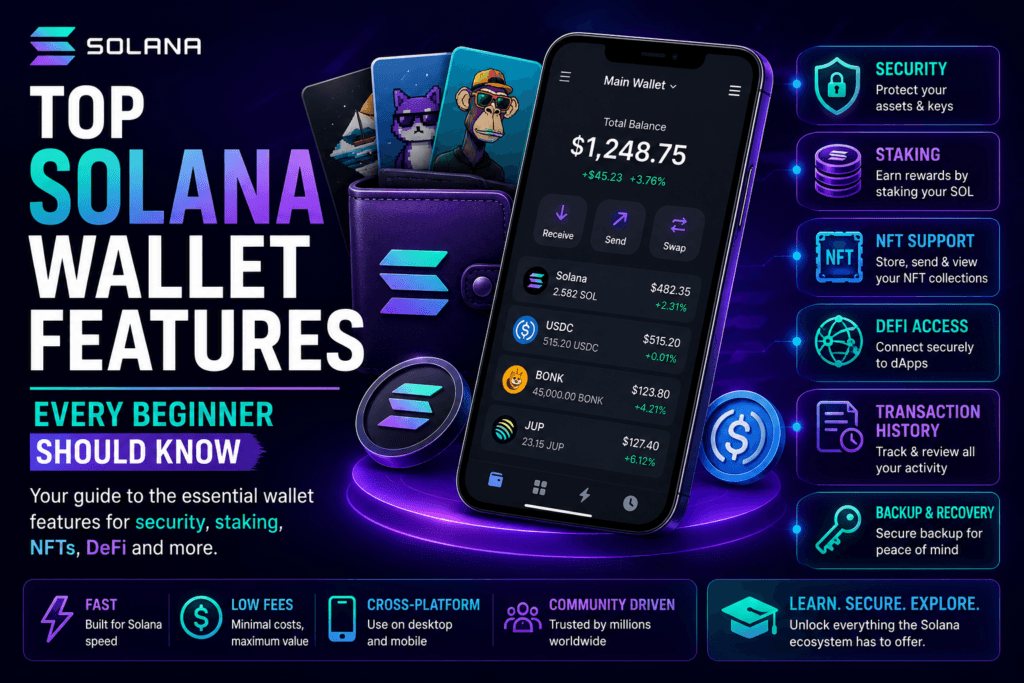
Top Solana Wallet Features Every Beginner Should Know
When most people think about a cryptocurrency wallet, they imagine a simple place to store digital coins. While that’s partly true, modern Solana wallets do much more than hold your SOL tokens. They serve as your gateway to the entire Solana ecosystem, allowing you to interact with decentralized applications (dApps), stake tokens, manage NFTs, and securely authorize blockchain transactions.
Choosing the right wallet—and understanding its features—is one of the most important decisions you’ll make as you begin exploring cryptocurrency. A well-designed wallet can make blockchain technology easier to use while helping protect your digital assets. On the other hand, not understanding how your wallet works can expose you to unnecessary risks.
In this guide, we’ll explore the essential features every beginner should understand before using a Solana wallet. Whether you choose Phantom, Solflare, Backpack, or another compatible wallet, these features will help you navigate the Solana ecosystem safely and confidently.
What Is a Solana Wallet?
A Solana wallet is a software application or hardware device that allows you to interact with the Solana blockchain.
Contrary to popular belief, your cryptocurrency isn’t actually stored inside the wallet itself.
Instead, the wallet securely manages the cryptographic keys that prove ownership of your digital assets on the blockchain.
With a wallet, you can:
- Store SOL and SPL tokens
- Send and receive cryptocurrency
- Connect to decentralized applications
- Stake SOL
- View NFTs
- Approve blockchain transactions
- Track transaction history
Your wallet becomes your digital identity within the Solana ecosystem.
If you’re completely new to Solana, our Solana Ecosystem Explained for Beginners article provides a helpful overview of how wallets fit into the broader blockchain ecosystem.
Public Keys and Private Keys
Every Solana wallet uses two important cryptographic components.
Public Key
Your public key functions similarly to an email address.
You can safely share it with others when receiving cryptocurrency.
Anyone can view your wallet address on the blockchain, but they cannot spend your funds using only your public key.
Private Key and Recovery Phrase
Your private key—or more commonly, your recovery phrase—is different.
This information provides complete access to your wallet.
Anyone who gains access to your recovery phrase can control your assets.
For this reason:
- Never share your recovery phrase.
- Never store it in unsecured cloud storage.
- Never enter it into websites unless restoring your own wallet.
- Always keep offline backups.
Protecting your recovery phrase is the single most important responsibility of every crypto user.
Our Solana Wallet Security Checklist explains additional best practices for keeping your wallet secure.
Feature 1: Token Management
One of the primary functions of a Solana wallet is managing digital assets.
Most wallets support:
- SOL
- SPL tokens
- Stablecoins such as USDC
- Community tokens
- Governance tokens
Instead of creating separate wallets for each token, compatible Solana wallets organize multiple assets in one interface.
This makes managing your portfolio much easier as you continue exploring the ecosystem.
Feature 2: NFT Support
Modern Solana wallets also serve as NFT managers.
Rather than using separate applications, your wallet allows you to:
- View NFT collections
- Send NFTs
- Receive NFTs
- Connect to NFT marketplaces
- Verify ownership
As NFTs expand beyond digital art into memberships, gaming, and digital identity, wallet support becomes increasingly important.
Our Understanding Solana NFTs Beyond Digital Art article explains how NFTs are being used across the Solana ecosystem.
Feature 3: Staking Integration
Many Solana wallets allow users to stake SOL directly within the wallet.
Instead of transferring your assets elsewhere, supported wallets let you:
- Choose a validator
- Delegate SOL
- View staking rewards
- Monitor staking performance
This simplifies participation in network security while making staking accessible to beginners.
If you’re unfamiliar with staking, our What Is Solana Staking? A Beginner’s Guide explains the basics.
Feature 4: DeFi Connectivity
One of the biggest advantages of Solana wallets is the ability to connect directly to decentralized applications.
With a compatible wallet, users can access:
- Decentralized exchanges (DEXs)
- Lending protocols
- DeFi applications
- Blockchain games
- NFT marketplaces
Rather than creating separate accounts for each platform, your wallet securely authorizes blockchain interactions.
However, always verify you’re connecting to an official website before approving wallet access.
Our Solana DeFi Explained for Beginners guide introduces the fundamentals of decentralized finance and explains how wallets connect to these applications.
Feature 5: Transaction History
Every blockchain transaction is recorded publicly.
Most wallets provide an easy-to-read transaction history that allows you to monitor:
- Incoming transfers
- Outgoing transfers
- NFT activity
- Staking actions
- Connected applications
Reviewing your transaction history regularly helps you identify unfamiliar activity and better understand how you’re interacting with the blockchain.
Feature 6: Wallet Backups
Responsible wallet ownership includes creating secure backups.
Most wallets generate a recovery phrase during setup.
This phrase allows you to restore access if:
- Your device is lost.
- Your computer fails.
- You purchase a new phone.
- You reinstall your wallet.
Without this recovery phrase, your wallet may not be recoverable.
Treat your backup with the same care you would important legal or financial documents.
Comparing Popular Solana Wallets
As you begin exploring the Solana ecosystem, you’ll quickly discover several wallet options. While each wallet is designed to securely interact with the Solana blockchain, they offer different features and user experiences.
Three of the most widely used wallets are:
Phantom
Phantom has become one of the most popular wallets for beginners because of its clean interface and ease of use.
Key features include:
- Beginner-friendly design
- NFT support
- Built-in staking
- DeFi connectivity
- Browser extension and mobile app
For many new users, Phantom provides an excellent introduction to the Solana ecosystem.
If you’re ready to create your first wallet, our Phantom Wallet Setup Guide for Beginners walks you through the process step by step.
Solflare
Solflare is another well-established Solana wallet with a strong focus on staking and security.
Features include:
- Native staking support
- NFT management
- Browser and mobile versions
- Hardware wallet compatibility
- Portfolio management
Many experienced Solana users appreciate its advanced functionality.
Backpack
Backpack is a newer wallet that has gained attention for its innovative approach to digital assets and application integration.
Features include:
- NFT support
- xNFT application capabilities
- Modern interface
- Secure wallet management
As the Solana ecosystem evolves, Backpack continues introducing features that support new blockchain experiences.
The best wallet for you depends on your personal preferences, security needs, and how you plan to interact with the Solana ecosystem.
Hardware Wallet Support
Software wallets are convenient, but many long-term cryptocurrency holders choose to pair them with a hardware wallet.
A hardware wallet stores your private keys on a dedicated physical device rather than on your computer or mobile phone.
Benefits include:
- Enhanced security
- Offline private key storage
- Protection from many online threats
- Additional approval required before transactions
Many popular Solana wallets support integration with hardware wallets, allowing users to enjoy both convenience and additional protection.
Understanding Wallet Permissions
Every time you connect your wallet to a decentralized application, you’re granting specific permissions.
It’s important to carefully review every approval request.
Before approving any transaction, ask yourself:
- Is this the official website?
- Do I understand what I’m approving?
- Does the transaction make sense?
- Have I verified the project?
Never approve a transaction simply because someone tells you it’s safe.
Taking a few extra moments to review wallet permissions can prevent costly mistakes.
Our Why Research Matters More Than Hype in Crypto article explains why slowing down and verifying information is one of the most valuable habits in cryptocurrency.
Beginner Best Practices
Developing good wallet habits early can help you avoid many common mistakes.
Protect Your Recovery Phrase
Store your recovery phrase offline in a secure location.
Never photograph it.
Never email it to yourself.
Never share it with anyone.
Keep Software Updated
Wallet developers regularly release updates that improve security, compatibility, and performance.
Keeping your wallet updated helps protect against newly discovered vulnerabilities.
Verify Every Website
Scam websites often imitate legitimate blockchain applications.
Bookmark official websites whenever possible and avoid clicking unfamiliar links shared through social media or direct messages.
Start Small
If you’re exploring staking, NFTs, or DeFi for the first time, consider using small amounts while you learn.
Building experience gradually is often more valuable than rushing into unfamiliar applications.
Your Wallet Is Your Digital Identity
As blockchain technology continues evolving, cryptocurrency wallets are becoming much more than tools for storing digital assets.
Today, wallets may also serve as your gateway to:
- Decentralized Finance (DeFi)
- NFT ownership
- Community memberships
- Blockchain gaming
- Digital identity
- Voting in governance proposals
- Payment applications
Understanding your wallet helps you participate more confidently throughout the Solana ecosystem.
Our Solana Ecosystem Explained for Beginners guide shows how wallets connect with every major part of the Solana blockchain.
Learn More From Official Resources
If you’d like to explore wallets officially supported throughout the Solana ecosystem, visit the Solana Ecosystem directory.
There you’ll find wallets, developer tools, DeFi applications, NFT marketplaces, payment solutions, and many other blockchain projects.
Official Solana Wallet Ecosystem
Final Thoughts
Your cryptocurrency wallet is much more than a place to store SOL.
It’s your personal gateway to everything the Solana ecosystem offers.
Whether you’re staking tokens, collecting NFTs, exploring decentralized finance, or simply sending cryptocurrency to another wallet, nearly every blockchain interaction begins with your wallet.
By understanding how wallets work—and by following strong security practices—you’ll be better prepared to explore blockchain technology safely and confidently.
Remember:
Learn before you connect.
Verify before you approve.
Research before you participate.
Those simple habits will serve you well throughout your crypto journey.
Frequently Asked Questions
Which Solana wallet is best for beginners?
Many beginners choose Phantom because of its intuitive interface and broad feature set. However, Solflare and Backpack are also excellent wallets with their own strengths.
Can I have more than one Solana wallet?
Yes.
Many users maintain multiple wallets for different purposes, such as long-term holdings, NFTs, testing new applications, or everyday transactions.
Is my cryptocurrency stored inside the wallet?
No.
Your cryptocurrency exists on the blockchain. Your wallet securely manages the private keys that allow you to access and control those assets.
What happens if I lose my phone?
If you’ve securely backed up your recovery phrase, you can generally restore your wallet on another compatible device.
Should I connect my wallet to every website?
No.
Only connect your wallet to trusted applications after verifying you’re using the official website.
Continue Learning
➡️ Solana Ecosystem Explained for Beginners
➡️ Phantom Wallet Setup Guide for Beginners
➡️ Solana Wallet Security Checklist
➡️ Solana DeFi Explained for Beginners
➡️ Understanding Solana NFTs Beyond Digital Art
➡️ Understanding Solana Validators and Staking Rewards
Ready To Learn More?
Continue exploring the Solana ecosystem and discover how communities, developers, and education are helping shape the future of blockchain technology.
About the Author
Scott Jones is the founder of SOSANA Hub and a cryptocurrency enthusiast committed to helping beginners confidently navigate the Solana ecosystem.
After learning cryptocurrency through years of trial and error—including encounters with scams, fake websites, and costly mistakes—Scott created SOSANA Hub to provide practical, beginner-friendly education that empowers readers to explore blockchain technology safely and responsibly.
Learn more about Scott’s crypto journey.
Affiliate Disclosure
SOSANA Hub participates in affiliate programs and may earn a commission when readers purchase products or sign up through qualifying referral links. These commissions help support the educational content published on this website at no additional cost to you.
The information provided on SOSANA Hub is for educational purposes only and should not be considered financial, legal, tax, or investment advice. Always conduct your own independent research and consult a qualified financial professional before making financial decisions.