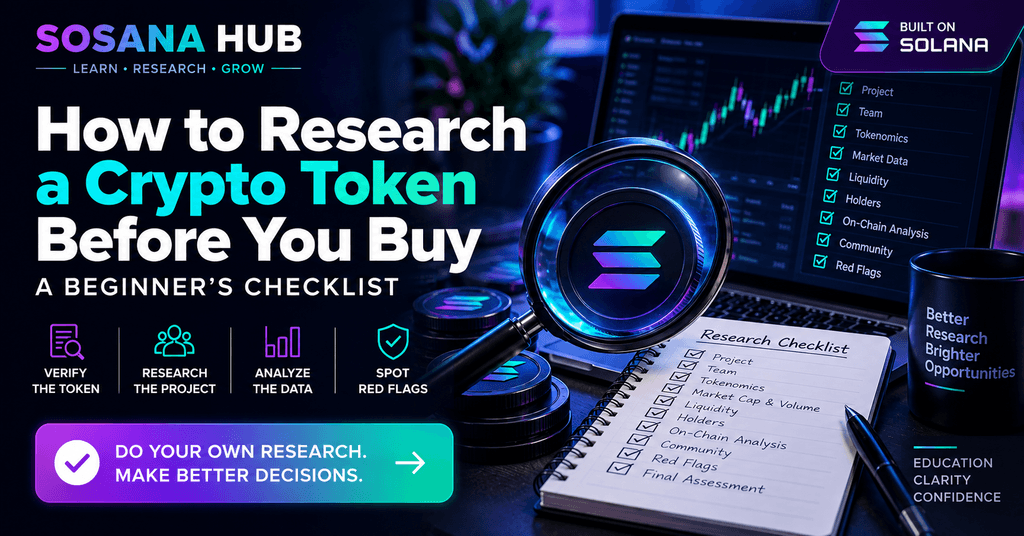
How to Research a Crypto Token Before You Buy: A Beginner’s Checklist.
Crypto moves fast. A token can suddenly appear across X, YouTube, Reddit, Telegram, or TikTok and seem like the next project everyone is talking about. Rising prices, enthusiastic communities, influencer posts, and impressive-looking websites can make it tempting to jump in before taking time to understand what you’re actually buying.
But excitement isn’t research.
Before putting money into an unfamiliar crypto token, you should understand the project, verify that you have found the correct token, examine its supply and distribution, and investigate the market surrounding it.
Research won’t tell you what a token’s price will do next. It won’t eliminate risk, either. What it can do is help you make a more informed decision based on evidence instead of hype.
That’s the philosophy behind SOSANA Hub:
Learn • Research • Grow
In Part 1 of this beginner’s guide, we’ll walk through some of the first questions you should investigate before buying or interacting with a crypto token.
Important: This article is for educational purposes only and is not financial or investment advice. Cryptocurrency and digital assets can be highly speculative and involve substantial risk. Always conduct your own research before making financial decisions.
Why Crypto Research Matters
Cryptocurrency markets can move dramatically in a short period of time.
Prices may react to market sentiment, regulatory developments, project announcements, exchange listings, social-media activity, broader economic conditions, or simple speculation.
That makes it especially important to separate information from excitement.
One of the easiest mistakes for beginners to make is assuming that popularity means credibility.
It doesn’t.
A token may have:
- Thousands of social-media followers
- An impressive website
- Influencer endorsements
- Rapidly rising prices
- An active Telegram or Discord community
- Professional-looking graphics
- Claims about major partnerships
None of these things, by themselves, establish that a token is legitimate, secure, fairly valued, or appropriate for you.
Investor-protection authorities have repeatedly warned people not to make investment decisions based solely on social-media information. Scammers can impersonate trusted people, manufacture excitement, create convincing websites, and use hype around crypto assets to attract potential victims.
External Resource: Investor.gov — Crypto and investment fraud education
That’s why the first SOSANA Hub rule is simple:
Research First. Decide Later.
Research isn’t about finding evidence that confirms what you already want to believe.
It’s about asking:
What do I actually know about this project?
What can I independently verify?
What don’t I know yet?
And perhaps most importantly:
What could go wrong?
If you can’t answer basic questions about a token, slowing down may be more useful than rushing into a decision.
Understanding What You’re Buying: Crypto Tokens 101
Before researching a particular token, understand what you’re looking at.
People often use terms such as cryptocurrency, coin, token, and digital asset interchangeably, but there are useful distinctions.
Coin vs. Token
A coin generally refers to the native asset of a blockchain.
For example:
SOL is the native asset of the Solana network.
Tokens, meanwhile, can be created on an existing blockchain.
Solana supports many different tokens through its token programs. These assets can represent anything from stablecoins and project tokens to other forms of digital assets.
Think about it this way:
Solana = Network
SOL = Native asset
Solana tokens = Assets created and managed using Solana’s token infrastructure
This distinction becomes important when you start researching unfamiliar projects.
Different Tokens Can Have Different Purposes
Not every token is designed to do the same thing.
You may encounter:
Utility tokens — Tokens intended to provide access to features, services, rewards, or functionality within a project.
Governance tokens — Tokens that may give holders certain voting or governance rights within a protocol or decentralized organization.
Stablecoins — Tokens designed to track another asset, commonly a fiat currency such as the U.S. dollar.
Meme tokens — Tokens often built around internet culture, humor, personalities, trends, or communities. These can be highly speculative.
There are other categories as well, and a token can sometimes fit into more than one category.
The important question isn’t simply:
“What type of token is this?”
You also want to know:
What Is This Token Supposed to Do?
Ask:
- Why does this token exist?
- What is it used for?
- Who is expected to use it?
- Does the project actually require a token?
- Is there a working product?
- Is its purpose clearly explained?
- Are its claims verifiable?
A complicated explanation isn’t necessarily a good explanation.
If you’ve spent considerable time researching a project and still can’t explain what the token does in simple language, that’s a reason to investigate further before putting money at risk.
Verify the Token Before Anything Else
One of the most important research steps happens before analyzing price charts, market capitalization, or social-media activity.
Make sure you’re researching the correct token.
A token’s name and ticker symbol are not enough.
Different tokens can have identical or very similar names and symbols.
Scammers may also create impersonator tokens designed to look like legitimate projects.
Find the Official Token Address
On Solana, a token is identified by its mint address.
Think of the mint address as a much more reliable identifier than the token’s display name or ticker.
Before interacting with an unfamiliar Solana token, try to verify its mint address using multiple reliable sources.
Possible sources may include:
- The project’s verified official website
- Official project documentation
- Reputable token-tracking platforms
- Established blockchain explorers
- Verified official project communication channels
Don’t rely on an address randomly posted in a social-media reply, Telegram message, Discord DM, YouTube comment, or advertisement.
Cross-Check Your Sources
Ideally, the mint address displayed across trusted sources should match.
If one source shows a different address, stop and investigate.
Even a single incorrect character means you’re looking at a different blockchain address.
This is why copying addresses from random posts is dangerous.
Watch for Fake Websites
Fraudulent websites can closely imitate legitimate crypto projects.
Before connecting a wallet, check:
- The domain name
- Spelling
- Whether you reached the site through a suspicious advertisement
- Whether the project’s verified channels point to the same domain
- Whether you’re being pressured to connect a wallet immediately
Never enter your wallet recovery or seed phrase into a website because it claims that doing so is required to verify, synchronize, restore, or upgrade your wallet.
Your recovery phrase should be treated as highly sensitive information.
Research the Project Behind the Token
Once you’ve verified the token itself, investigate the project behind it.
A token shouldn’t be evaluated only by its chart.
Start with the project’s official information.
Read the Website
Look beyond the homepage.
Try to determine:
- What the project actually does
- What problem it claims to address
- Who the intended users are
- Whether a product exists
- How the token fits into the project
- What stage of development the project has reached
Professional design alone isn’t proof of credibility.
A polished website can be created quickly, so treat it as a starting point—not proof.
Read the Documentation or Whitepaper
If the project provides documentation or a whitepaper, read it.
You don’t have to understand every technical detail.
Focus on basic questions:
What are they building?
Why are they building it?
How is the token used?
How is the project funded?
What milestones have already been completed?
What still depends on future promises?
Be cautious when documentation relies heavily on buzzwords but provides few details that can be independently checked.
Examine the Roadmap
A roadmap describes what a project says it intends to accomplish.
But remember:
A roadmap is a plan—not proof that the plan will happen.
Look at previous milestones.
Did the team accomplish what it previously announced?
Were deadlines repeatedly moved?
Were promised products actually released?
Historical execution can provide useful context when evaluating future claims.
Look for an Actual Product
Ask whether the project has something people can currently use.
This could be:
- An application
- Protocol
- Wallet
- Marketplace
- Blockchain service
- Developer platform
- Game
- Community product
- Other functioning technology
An early-stage project may legitimately still be building its product.
The key is distinguishing between:
What exists today
and
What the project says may exist tomorrow.
Don’t treat promises as completed accomplishments.
Check Development Activity—But Keep It in Perspective
Some crypto projects make their software development publicly visible through platforms such as GitHub.
This can provide another piece of information for your research.
You might examine:
- Recent updates
- Repository history
- Documentation
- Contributors
- Releases
- Development discussions
However, development activity should never be treated as proof that a project is legitimate, secure, or valuable.
A busy GitHub repository doesn’t guarantee a good project.
Likewise, a quiet repository doesn’t automatically mean a project has been abandoned because some development may happen privately.
Treat development activity as one data point among many.
Investigating the Team Behind the Project
Next, research the people responsible for the project.
Some crypto projects have fully public teams.
Others operate partially or completely anonymously.
Public Teams
For publicly identified founders and developers, investigate:
- Previous employment
- Previous projects
- Relevant experience
- Public professional profiles
- Interviews
- Past businesses
- Previous crypto projects
- Claims about qualifications
Don’t simply accept the biography published on the project’s own website.
Look for independent confirmation.
Verify Partnership Claims
Crypto projects sometimes prominently display company logos or announce partnerships.
Don’t assume a logo means a formal relationship exists.
Try to verify major partnership claims from the supposed partner’s own website, press releases, social accounts, or other reliable sources.
A claim made only by the crypto project should remain an unverified claim until supporting evidence can be found.
What About Anonymous Teams?
An anonymous development team doesn’t automatically make a project fraudulent.
Crypto has a long history of pseudonymous participation.
However, anonymity reduces some information available for due diligence.
That means you may need to place greater emphasis on:
- Verifiable development history
- On-chain activity
- Project transparency
- Security practices
- Documentation
- Token distribution
- Governance structure
- Community history
Don’t confuse anonymity with proof of fraud.
But don’t ignore the additional uncertainty either.
Understanding Tokenomics
Now we move into one of the most important areas of token research:
Tokenomics.
Tokenomics describes how a token’s supply, distribution, incentives, issuance and related economic mechanisms are structured.
You don’t need an economics degree to understand the basics.
Start with several numbers.
Circulating Supply
Circulating supply generally refers to tokens currently circulating and available to the public.
Suppose a project eventually expects to have:
1 billion tokens
but only:
200 million tokens
are currently circulating.
That difference matters.
The remaining supply may eventually enter circulation depending on the project’s token structure.
Total Supply
Total supply generally refers to the amount of tokens that currently exist, subject to how a particular data provider defines and accounts for burned or otherwise removed tokens.
Always check the methodology of the data source you’re using.
Maximum Supply
Some tokens have a defined maximum supply.
Others do not.
Maximum supply generally represents an upper limit defined by the token’s design, when such a limit exists.
Don’t assume every crypto asset has a fixed cap.
Investigate Token Allocation
Knowing the supply isn’t enough.
You also want to know:
Who received the tokens?
A project’s allocation may include tokens for:
- Founders
- Development team
- Early investors
- Venture investors
- Treasury
- Community incentives
- Staking rewards
- Liquidity
- Airdrops
- Ecosystem development
Distribution matters because large allocations controlled by a relatively small number of parties can create concentration and potential selling pressure.
But context matters.
A large wallet might belong to an exchange, treasury, liquidity pool or another project-related account rather than one individual investor.
This is why blockchain research shouldn’t stop at simply looking at the largest wallet.
We’ll examine holder distribution much more closely in Part 2.
Understand Vesting and Token Unlocks
Some tokens allocated to founders, employees, investors or other participants aren’t immediately available.
They may be subject to a vesting schedule.
For example, tokens could be released gradually over several months or years.
These releases are often called token unlocks.
Why should beginners care?
Because future unlocks can increase circulating supply.
That doesn’t automatically mean the token’s price will fall.
It means the supply dynamics are changing and deserve consideration.
Ask:
- How many tokens are currently circulating?
- How many remain locked?
- When are major unlocks scheduled?
- Who receives those tokens?
- How large are the unlocks relative to current circulating supply?
These questions provide more useful information than simply looking at today’s token price.
Understand Token Inflation and Dilution
Some token systems introduce additional tokens over time.
That may happen through:
- Staking rewards
- Validator incentives
- Ecosystem rewards
- Community incentives
- Scheduled emissions
- Other distribution mechanisms
Additional supply isn’t automatically bad.
What matters is understanding how the system works.
If circulating supply increases significantly, each existing token represents a smaller proportion of the overall circulating supply than before.
This is one reason token research should consider both current supply and future supply.
Market Capitalization: Look Beyond Token Price
One of the biggest mistakes beginners make is assuming a low token price means a token is cheap.
For example:
Token A = $0.01
Token B = $100
It may seem obvious that Token A has more room to increase.
But token price alone tells you very little.
You also need to consider supply.
Basic Market Cap Formula
A commonly used calculation is:
Market Capitalization = Current Token Price × Circulating Supply
Imagine a token trading at:
$0.01
with:
100 billion tokens circulating.
Its market capitalization would be:
$1 billion.
Now consider another token trading at:
$10
with:
10 million tokens circulating.
Its market capitalization would be:
$100 million.
Even though the second token costs far more per token, its market capitalization is much smaller.
That’s why saying:
“It’s only a penny, so imagine if it reaches $100!”
isn’t meaningful analysis by itself.
You must consider supply.
What Is Fully Diluted Valuation?
You’ll also encounter the abbreviation:
FDV
or:
Fully Diluted Valuation.
FDV is a theoretical valuation metric that estimates what the project’s market value could look like if the supply used by the calculation were fully in circulation at the current token price.
A simplified formula is:
FDV = Current Price × Fully Diluted Supply
FDV can help reveal the potential difference between today’s circulating valuation and a valuation based on a broader future supply.
But FDV has limitations.
It does not predict what the project will eventually be worth.
Future token prices can change dramatically, token schedules can change, and not every token necessarily enters circulation in the way a simplified calculation assumes.
Treat FDV as another research metric—not a price forecast.
Analyzing Trading Volume
Trading volume measures how much trading activity occurs over a particular period.
You’ll frequently see:
24-hour trading volume.
Volume can help you understand how actively a token is being traded.
However, don’t automatically assume:
High volume = good token.
or
Low volume = bad token.
Volume needs context.
Compare Volume With Other Metrics
Look at volume alongside:
- Market capitalization
- Liquidity
- Number of markets
- Exchange activity
- Price movement
- On-chain activity
An unusual spike in volume deserves investigation.
Ask:
Did something happen?
Maybe there was:
- A major announcement
- Exchange listing
- Token unlock
- Market-wide movement
- Viral social-media activity
- Large transaction
- Speculative trading
Or there may be activity that requires additional scrutiny.
Don’t make assumptions from the number alone.
Be Careful With Reported Trading Volume
Reported volume isn’t always a perfect measure of genuine market demand.
Some markets may experience artificial or manipulative trading activity.
One example is wash trading, where transactions can create the appearance of greater market activity than actually exists.
This is another reason to compare information across multiple reputable data sources rather than relying on a single number.
Think of trading volume as a clue.
Not a verdict.
Understanding Liquidity
Liquidity is one of the most important—and frequently misunderstood—concepts for beginner token researchers.
In simple terms:
Liquidity describes how easily an asset can be bought or sold without causing a large change in its price.
A token can show an impressive market price on your screen and still have poor liquidity.
That becomes especially important when someone tries to sell.
What Happens When Liquidity Is Low?
Imagine a small token suddenly rises 300%.
On paper, someone’s holdings may appear to have increased substantially.
But if there aren’t enough buyers or sufficient liquidity available, selling a large position could push the price sharply lower.
The displayed value of a wallet isn’t necessarily the amount someone could actually receive from selling the entire position.
That’s why liquidity deserves its own place in your research process.
What Are Liquidity Pools?
On decentralized exchanges, trading can occur through liquidity pools.
A liquidity pool contains assets used to facilitate swaps between tokens according to the rules of the underlying protocol.
For example, a pool might contain:
TOKEN / SOL
or
TOKEN / USDC
Traders interact with the pool when swapping between those assets.
The amount and structure of liquidity can affect how much a trade moves the price.
Understanding Slippage
Slippage refers to the difference between the expected price of a trade and the price at which it actually executes.
Larger trades in thin markets can experience greater price impact.
For beginners, the important lesson is:
A token’s displayed price doesn’t guarantee that you can buy or sell any amount at exactly that price.
Liquidity and market depth matter.
We’ll explore slippage in greater detail in a dedicated SOSANA Hub guide.
What About Locked or Burned Liquidity?
You may see crypto projects advertise:
“Liquidity Locked”
or
“Liquidity Burned.”
These terms deserve careful interpretation.
Depending on how a particular liquidity arrangement is structured, making liquidity-provider assets inaccessible for a period of time or permanently inaccessible may reduce the ability of a party to remove that particular liquidity position.
However:
Locked liquidity does NOT mean a token is safe.
It doesn’t guarantee:
- The token won’t lose value
- The project is legitimate
- Smart contracts or programs are secure
- Token distribution is healthy
- The team will complete its roadmap
- Large holders won’t sell
- Other vulnerabilities don’t exist
Liquidity status should therefore be treated as one part of a broader risk assessment, not a safety certificate.
The SOSANA Hub Research Rule
By this point, you may notice a pattern.
There isn’t one magic metric that tells you whether a token deserves your money.
Not market cap.
Not price.
Not trading volume.
Not liquidity.
Not GitHub activity.
Not the number of followers.
Not the team.
Not even a working product.
Good crypto research means putting multiple pieces of evidence together.
Our approach is:
Learn
Understand what you’re looking at.
Research
Verify information using multiple reliable sources.
Grow
Improve your ability to make independent, evidence-based decisions over time.
You don’t need to become a blockchain developer or professional analyst.
You simply need to become better at asking questions.
Part 1 Research Checkpoint
Before moving forward with an unfamiliar token, see whether you can answer these questions:
- What does the token actually do?
- Have I verified the correct mint or contract address?
- Can I explain the project’s purpose in simple language?
- Does the project have a working product or only future plans?
- Can major team and partnership claims be independently verified?
- What are the circulating, total and maximum supplies?
- How were tokens allocated?
- Are major token unlocks coming?
- How does additional supply enter circulation?
- What is the current market capitalization?
- What does FDV tell me—and what doesn’t it tell me?
- How active is trading?
- How much liquidity exists?
- Could I realistically exit a position without substantial price impact?
- Am I looking at evidence, or am I reacting to hype?
If you can’t answer several of these questions, that doesn’t automatically mean the project is bad.
It means:
Your research isn’t finished yet.
How to Research a Crypto Token Before You Buy: A Beginner’s Checklist
In Part 1, we learned that researching a crypto token involves much more than looking at its price.
We examined the project, token purpose, team, tokenomics, market capitalization, trading volume, liquidity, vesting schedules, and potential dilution. Those steps help build an initial picture of what you’re considering before putting money at risk.
But there’s another major advantage crypto gives researchers:
The blockchain itself can provide information.
On networks such as Solana, you can examine token information, transactions, accounts, supply data, and other on-chain activity using blockchain explorers and analytics tools.
That doesn’t mean blockchain data tells you whether a token will succeed.
It means you have another source of evidence.
In Part 2, we’ll learn how to examine token holders, use Solana blockchain explorers, understand token authorities, evaluate communities, identify warning signs, and bring everything together using the SOSANA Hub Beginner Token Research Checklist.
Our philosophy remains the same:
Learn • Research • Grow
Important: This article is for educational purposes only and is not financial or investment advice. Cryptocurrency and digital assets can be highly speculative and involve substantial risk. Research can help you understand risk, but it cannot eliminate it.
Check Who Holds the Token
One of the next areas to investigate is token distribution.
You already learned about allocation and circulating supply in Part 1.
Now we want to ask another question:
Where are those tokens actually concentrated?
Blockchain explorers and analytics platforms can help you examine token accounts and holder distribution.
Why Holder Concentration Matters
Imagine two hypothetical tokens.
Token A
The supply is distributed among thousands of token accounts, with no single non-project account controlling an unusually large percentage.
Token B
A small number of accounts appear to control a substantial portion of the supply.
These situations present different concentration risks.
If a small number of independent holders control a large percentage of a tradable supply, their actions could potentially have an outsized effect on the market.
But don’t immediately assume:
Large wallet = whale = bad.
You need context.
Understand What Large Token Accounts May Represent
A large token account may be associated with:
- An exchange
- Project treasury
- Liquidity pool
- Staking or protocol-related activity
- Custodian
- Vesting arrangement
- Project team
- Early investor
- Individual holder
- Another smart-contract or program-related account
This is why simply looking at the top ten accounts isn’t enough.
Your next question should be:
Can I determine what these accounts represent?
Sometimes you can.
Sometimes you can’t.
That uncertainty itself should become part of your research.
Look at Concentration, Not Just Holder Count
A project may advertise:
“We have 50,000 holders!”
That number sounds impressive.
But imagine that a small group of accounts still controls a substantial portion of the supply.
The holder count alone wouldn’t tell you that.
Research both:
How many token accounts exist?
and
How concentrated is the supply?
Neither number should be interpreted in isolation.
Learn to Use a Solana Blockchain Explorer
Blockchain explorers allow users to inspect publicly available information recorded on a blockchain.
For Solana research, explorers can help you investigate things such as:
- Token mint information
- Token supply
- Token accounts
- Transactions
- Transfers
- Wallet activity
- Program interactions
- Token authorities
One commonly used Solana explorer is Solscan.
There is also the official Solana Explorer.
You don’t need to become an on-chain analyst to benefit from these tools.
Start with the basics.
How to Begin Researching a Token on Solscan
When researching an unfamiliar Solana token, begin with the token’s verified mint address rather than relying only on its name.
Copy the mint address you’ve already verified.
Then search that address using a Solana blockchain explorer.
Depending on the explorer and token, you may be able to examine information related to the mint and associated token accounts.
Start With the Mint Address
This is worth repeating:
Search by mint address whenever possible.
Token names and ticker symbols can be copied.
The mint address identifies the specific token mint you’re researching.
Before analyzing anything else, make sure the address you’re viewing matches the address you independently verified.
Examine Token Activity
You can then begin looking at on-chain activity.
Ask:
- Does the activity appear recent?
- How frequently is the token moving?
- Are there unusually large transfers?
- Are large accounts sending tokens to other accounts?
- Are there patterns that deserve further investigation?
Don’t assume every large transaction is a sale.
A transfer could represent many things, including internal account movements, exchange activity, treasury activity, liquidity operations, or another legitimate transaction.
Blockchain explorers show you what happened on-chain.
Understanding why it happened can require additional research.
Understand Mint Authority
Solana tokens can have certain authorities associated with their mint.
One important concept is mint authority.
A mint authority can have permission to create additional units of a token mint when that authority exists and the token program permits the action.
That makes it something worth understanding during token research.
Questions to Ask
When investigating mint authority, ask:
- Does a mint authority currently exist?
- Who or what appears to control it?
- Does the project’s documentation explain why it exists?
- Does the token’s stated supply model match what you see?
- Are future emissions expected?
The presence of mint authority does not automatically mean a project is malicious.
Some legitimate token systems require ongoing issuance.
For example, a project’s token design may include scheduled emissions or incentives.
The important point is understanding whether the authority exists and whether its purpose is consistent with the project’s documentation.
Understand Freeze Authority
Another Solana token concept you may encounter is freeze authority.
Depending on the token configuration, a freeze authority can have permission related to freezing token accounts.
Again, don’t jump directly from:
Freeze authority exists
to
This token is a scam.
Instead ask:
Why does this authority exist?
Who controls it?
Is its purpose documented?
Does its existence change the risk I’m taking?
Research should help you understand permissions—not encourage you to make conclusions from a single technical field.
Token Authorities Are Research Signals, Not Verdicts
This distinction is extremely important.
Crypto research often becomes oversimplified on social media.
You may see statements such as:
“Mint authority revoked = safe.”
or:
“Liquidity locked = safe.”
or:
“Freeze authority disabled = safe.”
Those conclusions are too broad.
A token can have certain authorities removed and still have:
- Concentrated ownership
- Weak liquidity
- Poor tokenomics
- Security vulnerabilities
- Misleading marketing
- An unsustainable project
- Other technical or market risks
There is no single blockchain field that gives a token a safe stamp.
The goal is to combine multiple pieces of evidence.
Examine the Community Behind the Project
After investigating the blockchain, turn your attention back to people.
Community can play a major role in crypto projects.
But community size and community quality aren’t the same thing.
A project might have:
200,000 followers
while another has:
10,000 followers.
That doesn’t automatically tell you which community is healthier or which project is stronger.
Look Beyond Follower Counts
Investigate how people actually interact.
Look at platforms such as:
- X
- Discord
- Telegram
- YouTube
- Project forums
Ask:
Are people discussing the actual project?
Or is almost every conversation about:
Price?
“100x”?
“To the moon”?
Buying before it’s too late?
A healthy project community may still talk about price.
That’s normal.
But you also want to see discussion around:
- Development
- Product usage
- Governance
- Education
- Security
- Technical questions
- Project updates
- Problems
- Constructive criticism
Community activity should provide information—not just excitement.
Watch for Artificial Engagement
Large engagement numbers can sometimes create an illusion of popularity.
Look more closely.
Do comments appear genuine?
Are dozens of accounts posting nearly identical phrases?
Are replies unrelated to the original post?
Are accounts repeatedly posting promotional slogans?
Are most comments focused exclusively on price?
These patterns don’t automatically prove manipulation.
They simply provide another reason to investigate.
Remember:
Follower count is a metric.
Community credibility requires context.
Watch How the Project Handles Difficult Questions
One revealing area of research is how project representatives respond when community members raise legitimate concerns.
Look for questions about:
- Token supply
- Security
- Delays
- Token unlocks
- Treasury activity
- Development progress
- Partnerships
- Technical problems
Then examine the response.
Does the team provide evidence?
Does it explain what happened?
Does it acknowledge uncertainty?
Or does it simply dismiss criticism?
No project communicates perfectly.
But transparency can be an important part of your overall research.
Separate Marketing From Evidence
Crypto projects need marketing.
Marketing by itself isn’t suspicious.
The problem begins when marketing is treated as evidence.
Consider these statements:
“This will revolutionize crypto.”
“Huge partnership coming.”
“The next 100x token.”
“Major announcement soon.”
“Don’t miss this opportunity.”
These are claims or promotional statements.
They are not evidence.
Your job as a researcher is to ask:
What can I verify?
Be Careful With Influencer Promotions
Influencers can introduce you to projects you didn’t know existed.
That can be useful for discovery.
But discovery and verification are different things.
An influencer may:
- Own the token
- Receive tokens
- Receive compensation
- Have an affiliate relationship
- Participate in a sponsored promotion
- Have another financial incentive
That doesn’t automatically make their information false.
It means you should independently verify important claims before making a financial decision.
A useful rule is:
Let Social Media Give You Research Ideas—Not Research Conclusions.
If someone says:
“You need to look at this token.”
Your response shouldn’t immediately be:
BUY.
It should be:
RESEARCH.
Watch for FOMO
FOMO means:
Fear Of Missing Out.
It’s one of the most powerful psychological forces in speculative markets.
You see a token rising quickly.
Everyone seems to be talking about it.
Social media fills with screenshots showing profits.
You begin thinking:
“If I don’t buy now, I’m going to miss it.”
That’s precisely when slowing down becomes valuable.
Ask:
Has anything fundamentally changed?
Do I understand what I’m buying?
Have I verified the token?
Have I checked liquidity?
Have I investigated holders?
Am I reacting to evidence—or price movement?
Sometimes the best research decision is simply:
I don’t know enough yet.
Learn to Recognize Crypto Red Flags
A red flag doesn’t always prove that a project is fraudulent.
Think of red flags as signals telling you:
Investigate further.
Several red flags together may justify much greater caution.
Guaranteed Returns
Statements promising guaranteed profits should immediately deserve scrutiny.
Crypto prices are unpredictable.
No legitimate research process can guarantee what a speculative token will be worth in the future.
Extreme Price Predictions
Be skeptical of claims such as:
“Guaranteed 100x.”
“This token can’t lose.”
“$1,000 investment will become $1 million.”
Price predictions aren’t evidence.
Ask what assumptions would have to be true for the prediction to occur.
Pressure to Act Immediately
Be cautious when someone tells you:
“Buy right now.”
“Last chance.”
“Don’t research—just get in.”
“You only have ten minutes.”
Artificial urgency can interfere with careful decision-making.
Research should rarely require panic.
Requests for Your Recovery Phrase
This one is simple:
Never provide your wallet recovery or seed phrase because someone asks for it.
Be especially suspicious of anyone claiming to be:
- Customer support
- Wallet support
- Project administrators
- Moderators
- Exchange representatives
- Airdrop support
who asks for your recovery phrase.
Unverifiable Partnerships
If a project claims a major partnership, independently verify it.
Don’t rely solely on:
- Logos
- Screenshots
- Project announcements
- Influencer posts
Look for confirmation from the organization supposedly involved.
Suspicious Token Distribution
Large concentrations of supply deserve investigation.
Again:
Concentration doesn’t automatically equal fraud.
But you should understand who controls significant portions of the supply whenever that information can reasonably be determined.
Extremely Thin Liquidity
Low liquidity can make entering and exiting positions more difficult and can increase price impact.
A rapidly rising chart doesn’t solve a liquidity problem.
Always examine the market behind the displayed price.
Understand the Different Types of Crypto Risk
One of the biggest improvements you can make as a beginner researcher is to stop thinking of crypto risk as one thing.
There are multiple types of risk.
Market Risk
The token’s market price can decline.
Even projects with active development can experience major price declines.
Liquidity Risk
You may not be able to sell the amount you want near the displayed market price.
Tokenomics Risk
Future supply increases, unlocks, emissions, or concentrated allocations can change the token’s supply dynamics.
Concentration Risk
A relatively small number of parties may control significant amounts of the token.
Technical Risk
Programs, smart contracts, bridges, wallets, protocols, or other technology can contain vulnerabilities.
Team Risk
The people responsible for a project may fail to execute, abandon the project, make poor decisions, or provide misleading information.
Security Risk
Phishing, fake websites, malicious wallet requests, compromised accounts, impersonators, and other attacks can result in loss.
Regulatory Risk
Laws and regulations affecting crypto assets and platforms can change, and requirements differ between jurisdictions.
No checklist removes these risks.
Research helps you identify and understand them.
Build a Bull Case AND a Bear Case
This is one of the most useful habits you can develop.
After researching a token, don’t only write down why it could succeed.
Force yourself to explain why it could fail.
Your Bull Case
Ask:
What evidence supports the project?
For example:
- Working product
- Clear use case
- Transparent tokenomics
- Active development
- Growing usage
- Strong liquidity
- Credible team
- Useful technology
These are examples of factors you might investigate—not guarantees of future performance.
Your Bear Case
Now argue against yourself.
Ask:
- What if adoption doesn’t happen?
- What if competitors are better?
- What if development slows?
- What if large holders sell?
- What if token supply increases significantly?
- What if liquidity disappears?
- What if the token isn’t actually necessary for the product?
- What if my assumptions are wrong?
This helps combat confirmation bias—our natural tendency to notice information that supports what we already believe.
Ask What Would Change Your Mind
Before making a decision, ask yourself:
What evidence would cause me to change my opinion about this project?
This question is surprisingly powerful.
If your answer is:
“Nothing. I know this token is going up.”
you’re no longer researching objectively.
Good research leaves room for being wrong.
New information should be capable of changing your conclusion.
Know When You Don’t Have Enough Information
Sometimes research doesn’t produce a clear answer.
You may find:
- Anonymous wallets you can’t identify
- Incomplete tokenomics
- Missing documentation
- Conflicting supply figures
- Unverified partnership claims
- Limited development information
- Unclear authority structures
You don’t have to fill those gaps with assumptions.
You can simply write:
Unknown.
That’s a legitimate research conclusion.
In fact, recognizing what you don’t know can be one of the most important parts of due diligence.
The SOSANA Hub Beginner Token Research Checklist
Now let’s bring Parts 1 and 2 together.
Before buying or interacting with an unfamiliar crypto token, work through this checklist.
1. Understand the Project
- I can explain what the project does in simple language.
- I understand why the token exists.
- I reviewed the official website.
- I reviewed available documentation.
- I separated existing products from future promises.
2. Verify the Token
- I verified the correct token mint or contract address.
- I cross-checked the address using reliable sources.
- I verified that I’m using the project’s legitimate website.
- I avoided token addresses sent through unsolicited messages.
3. Research the Team
- I researched publicly available information about the team.
- I independently checked major credentials when possible.
- I independently checked major partnership claims.
- I understand whether the team is public, pseudonymous, or anonymous.
4. Understand Tokenomics
- I checked circulating supply.
- I checked total supply.
- I checked maximum supply, if applicable.
- I reviewed token allocation.
- I investigated vesting schedules.
- I looked for upcoming token unlocks.
- I understand how additional tokens may enter circulation.
5. Analyze Market Data
- I checked market capitalization.
- I understand the difference between price and market cap.
- I checked FDV when relevant.
- I checked trading volume.
- I investigated unusual volume or price activity rather than assuming what caused it.
6. Examine Liquidity
- I checked available liquidity.
- I understand that displayed price isn’t necessarily my execution price.
- I considered slippage and price impact.
- I investigated liquidity arrangements when relevant.
- I understand that locked liquidity doesn’t make a token automatically safe.
7. Investigate On-Chain Information
- I searched using the verified token mint address.
- I reviewed token-account or holder concentration where available.
- I investigated unusually large accounts where possible.
- I reviewed relevant transaction activity.
- I checked token authorities when applicable.
8. Evaluate the Community
- I looked beyond follower counts.
- I examined whether community conversations involve the actual project.
- I watched for artificial-looking engagement.
- I observed how legitimate questions are handled.
- I separated community enthusiasm from evidence.
9. Check for Red Flags
- No guaranteed-return claims influenced my decision.
- I investigated extreme price predictions.
- I resisted pressure to act immediately.
- I verified major partnership claims.
- I considered ownership concentration.
- I checked liquidity.
- I will never provide my recovery phrase to anyone.
10. Challenge Your Own Conclusion
- I wrote down reasons the project could succeed.
- I wrote down reasons the project could fail.
- I identified the biggest risks.
- I identified information that remains unknown.
- I know what evidence would change my opinion.
- I can explain my reasoning without relying on a price prediction.
The Final Question: Do You Understand What You’re Risking?
After completing your research, ask one final question:
Do I understand this token well enough to make my own decision?
Not:
“Will the price go up?”
Nobody can reliably answer that.
Instead ask:
What am I buying?
Why does it exist?
Who controls important parts of it?
What does the blockchain show?
What could cause this project to fail?
What risks am I accepting?
And:
What don’t I know?
If you can’t answer those questions, more research may be appropriate.
Walking away is also an option.
There will always be another token.
Final Thoughts: Research Doesn’t Predict the Future
Crypto research is not fortune-telling.
You can thoroughly investigate a project and still lose money.
You can identify a project with strong-looking fundamentals and watch the market move against it.
And sometimes projects change after you’ve completed your research.
That’s why due diligence isn’t something you perform once and forget.
Continue learning.
Continue verifying.
Continue questioning your own assumptions.
At SOSANA Hub, our goal isn’t to tell you which token to buy.
Our goal is to help you become capable of conducting your own research.
That’s what we mean by:
Learn • Research • Grow
Frequently Asked Questions
How Do I Research a Crypto Token Before Buying?
Start by verifying the token’s correct mint or contract address. Then research the project’s purpose, team, documentation, tokenomics, supply, market capitalization, trading volume, liquidity, holder distribution, on-chain activity, token authorities, community, and major risk factors.
No single metric should determine your decision.
How Can I Tell if a Crypto Token Is Legitimate?
There isn’t one test that proves a crypto token is legitimate.
Instead, verify information using multiple independent sources. Investigate the project’s website, documentation, token address, team claims, tokenomics, blockchain activity, security considerations, liquidity, holder distribution, and community.
Even extensive research cannot guarantee that a project is legitimate, secure, or successful.
How Do I Check Who Holds a Solana Token?
Start with the token’s verified mint address and use a Solana blockchain explorer or appropriate analytics platform to examine token accounts and distribution information.
Remember that large accounts may represent exchanges, liquidity pools, treasuries, custodians, programs, or other entities, so concentration data requires context.
Where Can I Find a Solana Token’s Mint Address?
Look for the mint address through reliable sources such as official project documentation and reputable blockchain or market-data services. Cross-check important information rather than trusting an address posted in an unsolicited message or social-media comment.
What Does Market Cap Tell Me About a Crypto Token?
Market capitalization is commonly calculated by multiplying a token’s current price by its circulating supply.
It provides more context than token price alone, but market cap does not tell you whether a token is safe, appropriately valued, or likely to increase in price.
Is Locked Liquidity Proof That a Crypto Token Is Safe?
No.
Depending on the arrangement, locked or otherwise inaccessible liquidity may reduce a particular party’s ability to remove that liquidity during the lock period.
It does not eliminate market, technical, tokenomics, concentration, team, security, or other risks.
What Are Some Major Crypto Token Red Flags?
Warning signs can include guaranteed returns, extreme price promises, pressure to act immediately, unverifiable partnerships, suspicious websites, unclear tokenomics, misleading marketing, thin liquidity, and requests for wallet recovery phrases.
A red flag is a reason to investigate further—not necessarily proof by itself that a project is fraudulent.
Can a Crypto Token Fail Even After I Research It?
Yes.
Research cannot eliminate uncertainty or predict future prices. Crypto assets can lose substantial or all of their value even when an investor has performed extensive due diligence.
The purpose of research is to help you better understand what you’re considering and the risks involved.
Continue Learning With SOSANA Hub
This two-part guide gives you a framework for researching unfamiliar crypto tokens, but each part of the process deserves deeper study.
Next, we’ll break these research skills into dedicated beginner guides covering topics such as:
Market capitalization • Liquidity • Token holders • Tokenomics • Solana blockchain explorers • Token authorities • Wallet security
Each guide will help you understand another piece of the research process.
Because better crypto decisions don’t start with a prediction.
They start with a question.
Ready To Learn More?
Continue building your Solana knowledge with SOSANA Hub.
Learn More About SOSANA
Learn • Research • Grow
Supporting Resources
For additional research and education, consider consulting primary and established educational sources, including:
Solana Documentation — Official documentation explaining Solana accounts, transactions, tokens, token programs, and token authorities.
Solana Explorer — A blockchain explorer for viewing publicly available Solana network information.
Investor.gov — U.S. investor education and alerts covering digital assets, investment fraud, social-media scams, and other investor risks.
When researching crypto, prioritize primary sources where possible and independently verify important claims.
About SOSANA Hub
SOSANA Hub is a beginner-focused educational resource designed to help people understand Solana, blockchain technology, wallet security, crypto research, and responsible participation in the digital-asset ecosystem.
Our philosophy is:
Learn • Research • Grow
We don’t believe better research guarantees better returns.
We believe better research helps people ask better questions.
Educational Disclaimer: SOSANA Hub provides educational information only. Nothing in this article should be interpreted as financial, investment, legal, tax, or trading advice. Crypto assets can be volatile and may result in substantial or total loss. Always conduct independent research and consider your individual circumstances before making financial decisions.