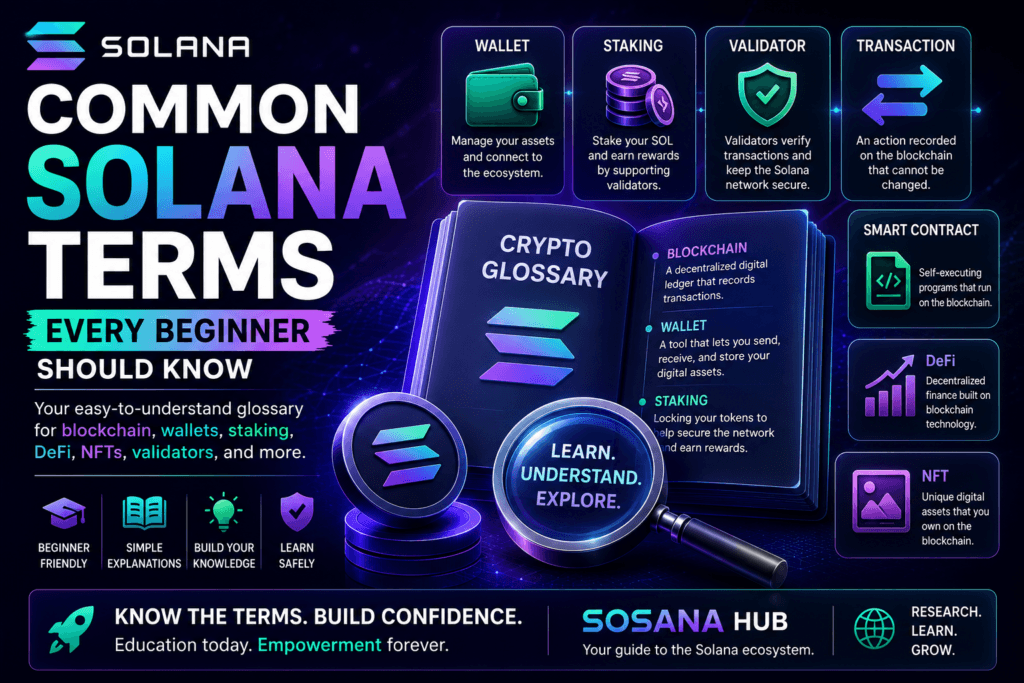
Common Solana Terms Every Beginner Should Know
When you first begin learning about cryptocurrency, it can feel like everyone is speaking a completely different language. Terms like blockchain, validator, staking, smart contract, and DeFi appear in nearly every article, video, and discussion. For beginners, this unfamiliar vocabulary can make blockchain technology seem far more complicated than it actually is.
The good news is that you don’t need to memorize every crypto term to get started. Like learning any new subject, understanding the most common concepts one step at a time will help you build confidence as you explore the Solana ecosystem. Once you understand the language, articles become easier to follow, communities become more approachable, and you’ll feel more comfortable researching new projects.
This glossary explains many of the most important Solana and blockchain terms using simple, beginner-friendly language. Think of it as your reference guide—one you can return to whenever you encounter a term you don’t recognize.
Why Learning the Language Matters
Every industry has its own vocabulary.
Doctors use medical terms.
Mechanics use automotive terms.
Software developers use programming terminology.
Blockchain is no different.
Learning these terms doesn’t make you an expert overnight, but it does make it easier to understand educational articles, official documentation, and community discussions.
If you’re completely new to Solana, our Solana Beginner Guide is an excellent place to begin before diving deeper into blockchain terminology.
Blockchain Fundamentals
Let’s start with the basic terms you’ll see most often.
Blockchain
A blockchain is a digital ledger that records transactions across a network of computers.
Instead of being controlled by one company or government, copies of the blockchain are maintained by many participants across the network.
Every new transaction becomes part of the blockchain, creating a transparent and permanent record.
Block
A block is a collection of verified transactions.
Once transactions are confirmed, they’re grouped into a block and permanently added to the blockchain.
Think of blocks as pages in a digital accounting book.
Transaction
A transaction is any action recorded on the blockchain.
Examples include:
- Sending SOL
- Receiving cryptocurrency
- Buying an NFT
- Staking tokens
- Swapping assets
Every transaction becomes part of the blockchain’s permanent history.
Wallet
A crypto wallet is software or hardware that allows you to access and manage your digital assets.
Your wallet enables you to:
- Send cryptocurrency
- Receive cryptocurrency
- Connect to decentralized applications
- Store NFTs
- Stake SOL
Our Top Solana Wallet Features Every Beginner Should Know guide explains these capabilities in greater detail.
Public Key
Your public key is similar to a bank account number.
You can safely share it with others when receiving cryptocurrency.
It identifies your wallet on the blockchain.
Private Key
Your private key proves ownership of your wallet.
Anyone with access to your private key can control your assets.
Private keys should never be shared.
Recovery Phrase (Seed Phrase)
A recovery phrase is a series of words generated when creating a wallet.
This phrase allows you to restore access if your device is lost or damaged.
Protect it carefully.
Never:
- Share it
- Email it
- Store it in unsecured cloud storage
Our Solana Wallet Security Checklist explains how to safely protect your recovery phrase.
Coin vs. Token
These two terms are often confused.
Coin
A coin is the native cryptocurrency of a blockchain.
For Solana, the native coin is SOL.
Token
A token is created on an existing blockchain.
Thousands of different tokens can exist on the Solana network.
Examples include:
- Stablecoins
- Community tokens
- Governance tokens
- Utility tokens
Solana-Specific Terms
Now let’s look at terms you’ll frequently encounter while exploring the Solana ecosystem.
SOL
SOL is the native cryptocurrency of the Solana blockchain.
SOL is commonly used to:
- Pay transaction fees
- Stake tokens
- Transfer value
- Participate in decentralized applications
SPL Token
SPL stands for Solana Program Library.
SPL tokens are digital assets created using Solana’s token standard.
They’re similar to ERC-20 tokens on Ethereum.
Many cryptocurrencies built on Solana use the SPL standard.
Validator
Validators help secure the Solana blockchain.
They verify transactions, produce blocks, and help keep the network operating.
When you stake SOL, you’re typically delegating your tokens to a validator.
Our Understanding Solana Validators and Staking Rewards article explains how validators contribute to the network.
Internal Link: Understanding Solana Validators and Staking Rewards → /understanding-solana-validators-and-staking-rewards/
Delegation
Delegation means assigning your staked SOL to a validator.
The validator performs network operations while your tokens remain under your ownership.
Staking
Staking allows SOL holders to help support the Solana network by delegating tokens to validators.
In return, participants may earn staking rewards depending on network conditions and validator performance.
If you’re new to staking, our What Is Solana Staking? A Beginner’s Guide explains the process in simple terms.
Epoch
An epoch is a defined period on the Solana blockchain.
Certain network activities, including staking reward calculations, occur on an epoch schedule.
Beginners don’t need to understand every technical detail, but you’ll often encounter this term while learning about staking.
RPC (Remote Procedure Call)
An RPC allows your wallet or application to communicate with the Solana blockchain.
Most users never need to configure an RPC manually, but advanced users may choose different RPC providers for improved performance or reliability.
Cluster
A cluster is a version of the Solana network.
Common clusters include:
- Mainnet Beta (live network)
- Devnet (developer testing)
- Testnet (network testing)
Most beginners will use Mainnet Beta, where real transactions take place.
DeFi Terms
As you continue learning about the Solana ecosystem, you’ll frequently encounter terms related to Decentralized Finance (DeFi). Understanding these concepts will help you better navigate decentralized applications and blockchain services.
DeFi
DeFi stands for Decentralized Finance.
It refers to financial services built on blockchain technology rather than traditional banks or financial institutions.
DeFi applications allow users to:
- Swap cryptocurrencies
- Lend digital assets
- Borrow funds
- Stake tokens
- Earn rewards
Instead of relying on banks, these services operate through smart contracts.
If you’d like to learn more, our Solana DeFi Explained for Beginners guide provides a beginner-friendly introduction.
Smart Contract
A smart contract is a computer program stored on a blockchain that automatically performs specific actions when predetermined conditions are met.
For example, smart contracts can:
- Execute token swaps
- Process lending transactions
- Distribute staking rewards
- Verify NFT ownership
Smart contracts remove the need for many traditional intermediaries while helping automate blockchain applications.
DEX (Decentralized Exchange)
A DEX is a Decentralized Exchange.
Instead of creating an account with a centralized company, users connect their wallets directly to trade supported cryptocurrencies.
Many DEXs use smart contracts to process trades automatically.
Liquidity Pool
A liquidity pool is a collection of digital assets used to facilitate trading on decentralized exchanges.
Instead of relying on traditional market makers, many DeFi applications use liquidity pools supplied by participants.
Liquidity pools help keep decentralized trading efficient.
Yield
Yield refers to rewards or returns earned through certain blockchain activities.
Depending on the platform, users may earn yield by:
- Staking
- Lending
- Providing liquidity
Yield opportunities vary, and they always involve different levels of risk.
Impermanent Loss
Impermanent loss is a term you’ll encounter when learning about liquidity pools.
It refers to changes in the value of deposited assets compared to simply holding those assets outside the pool.
This is a more advanced topic, but it’s helpful to recognize the term as you continue learning about DeFi.
NFT Terms
NFTs introduce their own vocabulary.
Fortunately, most of the key concepts are straightforward once explained.
NFT
NFT stands for Non-Fungible Token.
Unlike cryptocurrencies such as SOL, each NFT is unique and represents ownership of a specific digital asset.
NFTs can represent:
- Artwork
- Event tickets
- Memberships
- Gaming assets
- Digital collectibles
- Certifications
Our Understanding Solana NFTs Beyond Digital Art article explores these real-world use cases.
Mint
Minting is the process of creating a new NFT on the blockchain.
Once minted, the NFT receives a unique blockchain record that verifies its existence and ownership.
Collection
A collection is a group of related NFTs created as part of the same project.
Many collections share common artwork styles, themes, or utilities.
Metadata
Metadata describes information associated with an NFT.
It may include:
- Name
- Description
- Image
- Creator
- Attributes
- Traits
Metadata helps define what makes each NFT unique.
Royalties
Some NFT projects include royalties.
When supported by a marketplace, creators may receive a percentage of certain secondary sales. Royalty handling varies by platform and marketplace, so creators should review the policies of the marketplaces they use.
Security Terms
Security is one of the most important topics every crypto beginner should understand.
Phishing
Phishing is an attempt to trick users into revealing sensitive information.
Examples include:
- Fake wallet websites
- Fraudulent emails
- Scam text messages
- Impersonation on social media
Always verify website addresses before entering sensitive information.
Scam
A scam is any fraudulent attempt to steal cryptocurrency or personal information.
Scammers often create fake giveaways, investment opportunities, or websites designed to imitate legitimate projects.
Learning to recognize scams is an essential part of cryptocurrency education.
Hot Wallet
A hot wallet is connected to the internet.
Examples include:
- Browser wallets
- Mobile wallets
- Desktop wallets
Hot wallets provide convenience but require good security practices.
Cold Wallet
A cold wallet stores private keys offline.
Hardware wallets are common examples.
Because they remain disconnected from the internet until needed, cold wallets generally provide additional protection for long-term holdings.
Hardware Wallet
A hardware wallet is a physical device designed to securely store private keys offline.
Many experienced cryptocurrency users use hardware wallets to help protect larger holdings.
Learning Doesn’t Stop Here
The cryptocurrency industry evolves quickly.
New technologies, applications, and terminology continue appearing every year.
Rather than trying to memorize every term, focus on understanding the concepts gradually.
The more you read, participate in communities, and explore educational resources, the more familiar this vocabulary will become.
One of the best habits you can develop is researching unfamiliar terms whenever you encounter them.
Our Why Research Matters More Than Hype in Crypto article explains why curiosity and education are some of the most valuable tools any crypto participant can have.
Continue Learning Through Official Resources
The official Solana documentation is an excellent resource for learning more about blockchain technology, wallet development, validators, staking, tokens, and the broader Solana ecosystem.
Final Thoughts
Learning blockchain terminology isn’t about memorizing definitions—it’s about building confidence.
Every experienced crypto participant started as a beginner.
By understanding the language of blockchain technology, you’ll be better prepared to read educational articles, participate in communities, evaluate projects, and make informed decisions.
Remember that you don’t need to learn everything at once.
Focus on one concept at a time.
Ask questions.
Continue researching.
Stay curious.
Over time, these terms will become second nature, making it much easier to explore everything the Solana ecosystem has to offer.
Frequently Asked Questions
What’s the difference between a coin and a token?
A coin is the native cryptocurrency of a blockchain, such as SOL on Solana. A token is created on an existing blockchain and can represent many different types of digital assets.
What is SOL?
SOL is the native cryptocurrency of the Solana blockchain. It is commonly used for transaction fees, staking, and interacting with decentralized applications.
What is staking?
Staking allows SOL holders to delegate tokens to validators, helping secure the network while potentially earning staking rewards.
What is a validator?
Validators verify blockchain transactions, produce new blocks, and help maintain the Solana network.
Do I need to memorize all of these terms?
No.
Use this guide as a reference whenever you encounter unfamiliar blockchain terminology. As you continue learning, many of these concepts will become familiar through regular use.
Continue Learning
➡️ Solana Ecosystem Explained for Beginners
➡️ Solana DeFi Explained for Beginners
➡️ Understanding Solana NFTs Beyond Digital Art
➡️ Solana Wallet Security Checklist
➡️ Understanding Solana Validators and Staking Rewards
Ready To Learn More?
Continue exploring the Solana ecosystem and discover how communities, developers, and education are helping shape the future of blockchain technology.
About the Author
Scott Jones is the founder of SOSANA Hub and a cryptocurrency enthusiast dedicated to helping beginners confidently navigate the Solana ecosystem.
After learning cryptocurrency through years of trial and error—including encounters with scams, fake websites, and costly mistakes—Scott created SOSANA Hub to provide educational resources that help others make informed decisions while exploring blockchain technology.
Learn more about Scott’s crypto journey.
Affiliate Disclosure
SOSANA Hub participates in affiliate programs and may earn a commission when readers purchase products or sign up through qualifying referral links. These commissions help support the educational content published on this website at no additional cost to you.
The information provided on SOSANA Hub is for educational purposes only and should not be considered financial, legal, tax, or investment advice. Always conduct your own independent research and consult a qualified financial professional before making financial decisions.