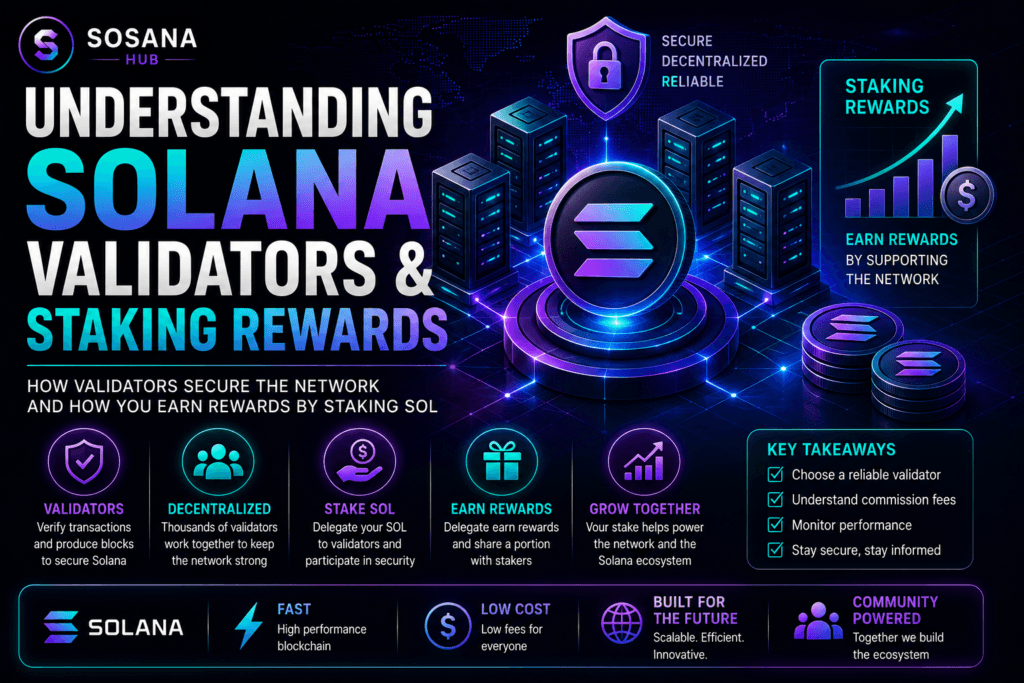
Understanding Solana Validators and Staking Rewards
If you’ve spent any time learning about Solana, you’ve probably encountered the term “staking.” Many cryptocurrency holders stake their SOL tokens to help support the network while potentially earning rewards. However, before you stake your SOL, it’s important to understand what happens behind the scenes.
Validators play a critical role in the Solana ecosystem. They help process transactions, maintain network security, and keep the blockchain operating efficiently. Staking allows SOL holders to participate in that process without running their own validator. Understanding how validators work and how staking rewards are generated can help you make more informed decisions as you explore the Solana ecosystem.
What Is a Solana Validator?
A validator is a computer system that helps verify transactions and maintain the Solana blockchain.
Validators are responsible for:
- Confirming transactions
- Producing blocks
- Maintaining network security
- Supporting decentralization
- Helping keep the blockchain operational
Without validators, the network would not be able to process transactions or maintain consensus.
Think of validators as the infrastructure that keeps the Solana network running.
Why Validators Matter
Blockchain networks rely on trustless verification.
Rather than relying on a central company or institution, validators collectively verify activity across the network.
This provides several benefits:
Security
Validators help protect the network from malicious activity.
Decentralization
No single organization controls the network.
Reliability
Thousands of participants help maintain network uptime.
Scalability
Validators allow Solana to process large numbers of transactions efficiently.
The strength of a blockchain often depends on the quality and distribution of its validators.
What Is Staking?
Staking allows SOL holders to delegate their tokens to validators.
Importantly:
You are not transferring ownership of your SOL.
Instead, you’re assigning voting power associated with your tokens to a validator.
The validator uses that delegated stake as part of its role in securing the network.
If you’re new to staking, start with our What Is Solana Staking? A Beginner’s Guide.
How Staking Rewards Work
Validators earn rewards for participating in network operations.
A portion of those rewards may be shared with users who delegate stake to them.
Rewards are generally influenced by factors such as:
- Validator performance
- Validator commission rates
- Network participation
- Protocol-level reward mechanisms
It’s important to understand that staking rewards are not guaranteed and can change over time.
What Is Validator Commission?
Validators typically charge a commission fee.
This fee represents a percentage of staking rewards retained by the validator for operating infrastructure and maintaining services.
For example:
A validator with a 5% commission keeps 5% of rewards and distributes the remaining portion to delegators.
Commission rates vary between validators.
Lower commission is not always better.
Reliability and performance are often more important factors.
How to Choose a Validator
Selecting a validator is one of the most important staking decisions you’ll make.
Factors to evaluate include:
Uptime
How consistently is the validator operating?
Performance
Does the validator successfully participate in network operations?
Reputation
Does the validator have a positive track record?
Community Involvement
Many validators contribute educational resources and ecosystem support.
Commission Rate
Understand how rewards are shared.
Choosing a reliable validator may help improve your overall staking experience.
Staking Through Phantom Wallet
Many beginners use Phantom Wallet because it provides a simple staking experience.
Within Phantom, users can:
- View available validators
- Delegate stake
- Monitor rewards
- Manage staking positions
If you haven’t yet set up a wallet, review our Phantom Wallet Setup Guide for Beginners.
Risks of Staking
Although staking is popular, it’s important to understand potential risks.
Validator Performance
Poorly performing validators may earn fewer rewards.
Market Volatility
The value of SOL can rise or fall regardless of staking activity.
Operational Risks
Blockchain networks and validators can experience technical issues.
Liquidity Considerations
Some staking methods may require waiting periods before funds become available.
Understanding risks is part of responsible participation.
Security Still Matters
Even when staking, wallet security remains critical.
Protect:
- Recovery phrases
- Wallet credentials
- Connected applications
Always verify websites before connecting your wallet.
For additional protection strategies, review our Solana Wallet Security Checklist.
Why Staking Supports Ecosystem Growth
Staking helps strengthen the Solana ecosystem by encouraging participation and network security.
As more users stake responsibly:
- Network security improves
- Decentralization increases
- Community engagement grows
- Ecosystem stability may benefit
This participation is one reason Solana continues attracting developers, builders, and community members.
To learn more, read Why Solana Is Growing So Fast.
Learn More From Official Sources
The Solana Foundation provides educational information about staking, validators, and network participation.
Review the official Solana Staking Documentation for additional details and updates.
Frequently Asked Questions
Do I lose ownership of my SOL when staking?
No.
Delegating stake does not transfer ownership of your tokens.
Are staking rewards guaranteed?
No.
Rewards can vary based on validator performance and network conditions.
Can I choose my validator?
Yes.
Most wallets allow you to select a validator.
Is staking risky?
All cryptocurrency activities involve risk, including staking.
Always research before participating.
Continue Learning
➡️ What Is Solana Staking?
➡️ Phantom Wallet Setup Guide
➡️ Solana Wallet Security Checklist
➡️ Why Solana Is Growing So Fast
Ready To Learn More?
Continue exploring the Solana ecosystem and discover how communities, developers, and education are helping shape the future of blockchain technology.
About the Author
Scott Jones is the founder of SOSANA Hub and a cryptocurrency enthusiast focused on helping beginners navigate the Solana ecosystem more safely and confidently.
After learning crypto through years of trial and error—including costly mistakes, fake websites, and security lessons—Scott created SOSANA Hub to share educational resources that help others avoid common pitfalls and make more informed decisions.
Learn more about Scott’s crypto journey →
Affiliate Disclosure
SOSANA Hub may receive compensation through referral links. Content is provided for educational purposes only and should not be considered financial, legal, tax, or investment advice.