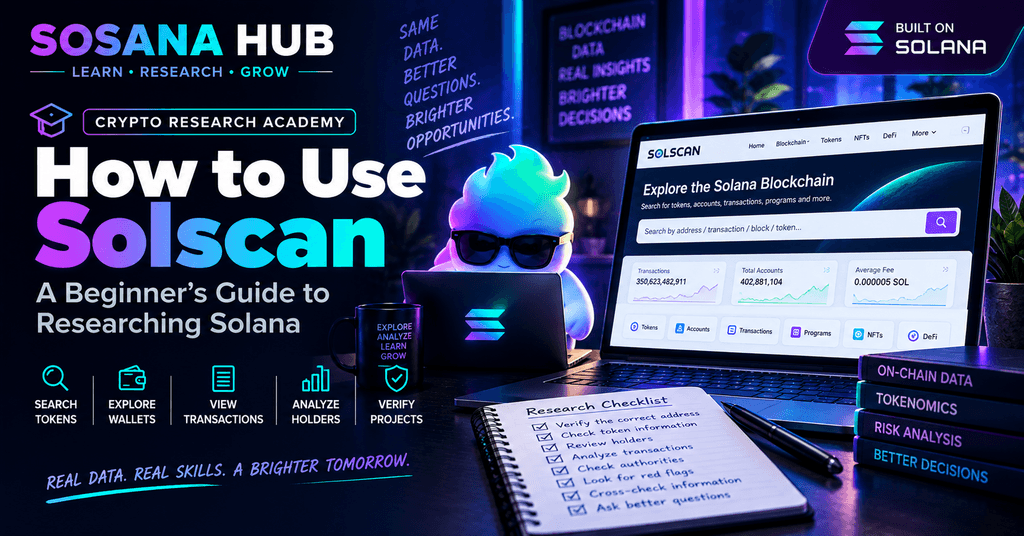
SOSANA HUB CRYPTO RESEARCH ACADEMY • MODULE 2
How to Use Solscan: A Beginner’s Guide to Researching Solana
You’ve found a Solana token that looks interesting. Maybe you saw it mentioned on social media, discovered it inside your wallet, or heard about it from someone in a crypto community. Before relying on what other people say about the project, there is another place you can look: the blockchain itself. Solscan can help you explore publicly available Solana blockchain information, but knowing what the data does—and does not—tell you is essential.
This beginner’s guide will show you how to use Solscan as part of a broader crypto research process. We’ll look at tokens, wallet addresses, transactions, token holders and authorities, while also explaining some of the mistakes beginners can make when interpreting blockchain information.
🎓 What You’ll Learn
By the end of this guide, you should have a better understanding of how to:
- Navigate a Solana blockchain explorer
- Search using wallet addresses and token mint addresses
- Review basic token information
- Examine token holders and distribution
- Look up Solana transactions
- Understand mint and freeze authority
- Recognize limitations of on-chain research
- Ask better questions about the information you find
What Is Solscan?
Solscan is a blockchain explorer for the Solana network. A blockchain explorer gives users a way to view information recorded on a public blockchain through a searchable web interface.
Instead of trying to read raw blockchain data directly, an explorer organizes that information into pages that are easier for people to navigate.
Depending on the type of address or transaction you’re examining, a blockchain explorer may help you investigate information such as:
- Solana accounts and addresses
- Token mints
- Token balances
- Transactions
- Token transfers
- Token accounts
- Token supply information
- Programs involved in transactions
- Some token authorities and metadata
This makes blockchain explorers useful research tools—but they are not investment-rating systems.
If you haven’t already learned our complete research framework, read How to Research a Crypto Token Before You Buy alongside this guide.
Why Should Beginners Learn to Use a Blockchain Explorer?
One of the easiest mistakes to make in crypto is allowing someone else to do all of your thinking for you.
A social-media post might say that a project has thousands of holders. A website might advertise a particular token supply. Someone in a community might point to a large transaction and claim that a “whale is buying.”
A blockchain explorer gives you another source of information you can examine for yourself.
That does not mean you will always know what the information means. In fact, learning to say “I don’t know” is an important research skill.
The goal isn’t to turn every beginner into a blockchain analyst. The goal is to become less dependent on unsupported claims.
Before You Search: Find the Correct Address
This is one of the most important lessons in this entire guide.
Crypto tokens can share similar names and ticker symbols. Fraudulent or unrelated tokens can also be created with names designed to resemble legitimate projects.
For that reason, searching for a token by name alone may not be enough.
What Is a Token Mint Address?
On Solana, a token mint is the account that defines a token. It contains important information about that token, including its supply and certain authority settings.
The mint address is therefore a much more precise identifier than simply using a token’s name or ticker.
Before researching an unfamiliar token, try to verify its correct mint address using reliable sources associated with the project and cross-check that address when possible.
How to Search on Solscan
Once you have the information you want to investigate, the search bar becomes your starting point.
Different types of searches can lead to different kinds of pages.
| What You Have | What You May Be Able to Research |
|---|---|
| Token mint address | Token information, supply, token accounts, holders, transfers and other available token data |
| Wallet/account address | Balances, token accounts and publicly recorded activity associated with the address |
| Transaction signature | Transaction status, accounts, instructions, transfers and other transaction details |
How to Research a Solana Token With Solscan
Let’s imagine you have already verified a token’s mint address.
Your goal is not to find one green checkmark that tells you whether the project is “safe.” Instead, you are gathering pieces of evidence.
Understanding Token Supply
Token supply is one of the first pieces of information many researchers examine, but it needs context.
For example, you may encounter terms such as total supply, circulating supply and maximum supply on different research platforms. Those figures do not necessarily mean the same thing.
Blockchain data can help you investigate how many token units currently exist on-chain, while market-data services may use additional methodology to estimate how much of that supply is actually circulating.
This is one reason SOSANA Hub recommends using multiple research sources rather than treating one platform as the complete answer.
How to Examine Token Holders
Holder distribution can be useful when researching a token, but it is also one of the easiest areas for beginners to misinterpret.
Imagine that one account appears to control a very large percentage of a token’s supply.
Your first reaction might be:
“A whale owns all those tokens.”
Maybe—but you don’t know that yet.
A large token account could potentially be associated with a project treasury, exchange, liquidity arrangement, vesting structure, smart contract or another type of account. It may also represent an individual holder.
The blockchain shows the account and its activity. It does not automatically explain the real-world reason for the balance.
Questions to Ask About Token Distribution
- How concentrated does the supply appear?
- Are several large token accounts present?
- Are any of those accounts identified by reliable sources?
- Does project documentation explain treasury allocations?
- Are tokens subject to vesting or unlock schedules?
- Could a large account represent infrastructure rather than an individual?
- What information remains unknown?
We will explore this subject much more deeply in the upcoming Research Academy module on researching token holders.
How to Look at a Solana Wallet or Account
A public Solana address can reveal information about its on-chain activity.
Depending on the account and explorer interface, you may be able to review SOL balances, token accounts, transaction history and transfers.
This can be useful when you’re trying to understand how an address interacts with the Solana ecosystem.
However, there is an important distinction:
Address ≠ Confirmed Identity
A blockchain address is not automatically proof of the real-world identity controlling it.
Unless reliable evidence links an address to a particular person, company, exchange or project, avoid making identity claims based only on the blockchain address.
How to Look Up a Solana Transaction
Every successful Solana transaction has information that can be inspected through a blockchain explorer.
A transaction page may initially look intimidating because there can be addresses, instructions, programs and balance changes displayed together.
Don’t try to understand everything at once.
Start With These Questions
- Did the transaction succeed or fail?
- When did it occur?
- Which accounts were involved?
- Were SOL or tokens transferred?
- Which programs were involved?
- What fees were recorded?
- Are there instructions you do not understand?
On Solana, a transaction can contain one or more instructions. Those instructions tell programs what actions to execute. That means a transaction may represent something more complex than a simple transfer.
This is another reason to avoid looking at a transaction and immediately deciding that someone “bought,” “sold,” or “dumped” a token.
What Is Mint Authority?
Mint authority is an important concept when researching Solana tokens.
For traditional SPL tokens, the mint authority is the authority permitted to mint additional token units. An authority can also be changed or revoked depending on the token configuration.
If the mint authority has been revoked, additional tokens cannot simply be minted using that revoked authority.
If mint authority remains active, researchers should ask why. There may be legitimate reasons for a project to retain certain controls, depending on how the token is designed.
What Is Freeze Authority?
Freeze authority is another token control researchers may encounter.
For tokens that support it, a freeze authority can freeze token accounts, restricting certain token-account actions until those accounts are thawed.
That sounds alarming when you first hear it, but context matters.
Some token designs may intentionally use administrative or compliance controls. Other projects may choose to revoke those controls.
Your research question should therefore not simply be:
“Is there a freeze authority?”
Ask:
“Does a freeze authority exist, who controls it, why does the project say it exists, and does that explanation fit the token’s intended design?”
How to Investigate Unusual Token Activity
Eventually you may notice something that catches your attention:
- A very large transfer
- Tokens moving between several large accounts
- A large balance suddenly changing
- Unusual transaction activity
- Movement involving a known service or program
This is where research discipline becomes especially important.
Separate what the blockchain shows from what you think it means.
| Observation | Unsupported Conclusion |
|---|---|
| A large token transfer occurred. | “A whale just dumped.” |
| A large account received tokens. | “An insider is accumulating.” |
| Tokens moved to another address. | “The project is selling.” |
| A wallet holds many tokens. | “This belongs to the developer.” |
The observation may be supported by blockchain data. The conclusion requires additional evidence.
What Solscan Cannot Tell You
Blockchain explorers are powerful research tools, but they have limits.
Solscan cannot reliably tell you:
- Whether a token’s price will rise
- Whether you should buy a token
- Whether a project will succeed
- The motive behind every transaction
- The real-world identity behind every address
- Whether marketing claims are truthful
- Whether a development team will deliver its roadmap
- Whether an investment is suitable for you
This is why on-chain research should be combined with project research, tokenomics, liquidity analysis, security research and independent verification.
7 Common Solscan Mistakes Beginners Should Avoid
1. Searching Only by Token Name
Token names and ticker symbols are not unique enough to be your only method of identification. Verify the mint address.
2. Treating Every Large Account as a Whale
Investigate what an account may represent before assigning an identity or motive.
3. Assuming Every Transfer Is a Trade
A blockchain transfer does not automatically tell you why the transfer occurred.
4. Using One Metric to Judge a Project
No holder count, transaction count, authority setting or other single metric can prove that a token is safe or a good investment.
5. Ignoring Project Documentation
Blockchain research and off-chain project research should complement one another.
6. Filling Unknowns With Assumptions
If you cannot determine what an address represents, write down unknown. That’s better research than guessing.
7. Treating an Explorer Like an Investment Advisor
Solscan displays blockchain information. It does not make investment decisions for you.
The SOSANA Hub Solscan Research Routine
You don’t need to remember every field on a blockchain explorer.
Instead, remember this six-step research routine:
VERIFY → SEARCH → IDENTIFY → EXAMINE → CROSS-CHECK → QUESTION
- VERIFY: Confirm that you have the correct token or address.
- SEARCH: Use the address or transaction signature to locate the relevant blockchain information.
- IDENTIFY: Determine what you’re actually looking at—a mint, account, token account or transaction.
- EXAMINE: Review the relevant supply, holder, transaction, authority or activity information.
- CROSS-CHECK: Compare important findings with independent and primary sources.
- QUESTION: Separate facts from assumptions and record what you still do not know.
A Simple Example
Imagine you discover a fictional Solana token called Example Token.
A social-media post claims:
“Example Token is completely decentralized and has thousands of holders.”
Instead of immediately accepting or rejecting that statement, you could break the claim into research questions:
- What is the verified mint address?
- What supply information is visible?
- How many token accounts or holders are shown?
- How concentrated is the token distribution?
- Do important token authorities remain active?
- What does “decentralized” mean in this project’s context?
- Does the project’s documentation support the claim?
Notice what we did not ask:
“Is this token going to 10x?”
That is the difference between investigating evidence and trying to predict a market.
Solscan Beginner Research Checklist
Before You Finish Your Research, Ask:
- ☐ Did I verify the correct mint address?
- ☐ Did I review the token’s basic information?
- ☐ Did I examine available supply information?
- ☐ Did I look at holder/token-account distribution?
- ☐ Did I investigate unusually large accounts?
- ☐ Did I review relevant transaction activity?
- ☐ Did I check token authorities where applicable?
- ☐ Did I cross-check important claims?
- ☐ Did I separate observations from assumptions?
- ☐ Did I write down information I couldn’t verify?
Frequently Asked Questions About Solscan
Is Solscan a crypto wallet?
No. Solscan is a blockchain explorer. It is used to browse and inspect publicly available Solana blockchain information.
Can someone see my Solana wallet on Solscan?
Activity associated with public blockchain addresses can be viewed through blockchain explorers. However, a public address does not automatically reveal the real-world identity of the person controlling it.
Can Solscan tell me whether a token is a scam?
No. Blockchain information may reveal factors that deserve further investigation, but no explorer can guarantee that a project is legitimate, safe or suitable as an investment.
What is a Solana mint address?
A mint address identifies a token mint on Solana. The mint stores information related to the token, including supply, decimals and authority settings.
What is a transaction signature?
A transaction signature can be used to identify and look up a particular Solana transaction through a blockchain explorer.
Does a revoked mint authority mean a token is safe?
No. Revoked mint authority provides information about one specific control. It does not evaluate liquidity, token distribution, project legitimacy, smart-contract risks, management or future performance.
Continue Your Crypto Research Education
Learning how to use Solscan is only one part of becoming a better crypto researcher.
Return to the SOSANA Hub Crypto Research Academy to continue building your research skills.
If you’re still building your Solana foundation, visit our SOSANA Hub Start Here learning center .
Ready To Learn More?
Continue exploring the Solana ecosystem and discover how communities, developers, and education are helping shape the future of blockchain technology.
🚀 Learn More About SOSANAAffiliate Disclosure: This is an affiliate/referral link. SOSANA Hub may receive compensation if you choose to participate through this link, at no additional cost to you. Cryptocurrency involves risk. This content is educational and is not financial advice.
About SOSANA Hub
SOSANA Hub is a beginner-focused educational resource for learning about Solana, blockchain technology, wallet safety, crypto research and responsible participation. Our approach is simple: Learn • Research • Grow.