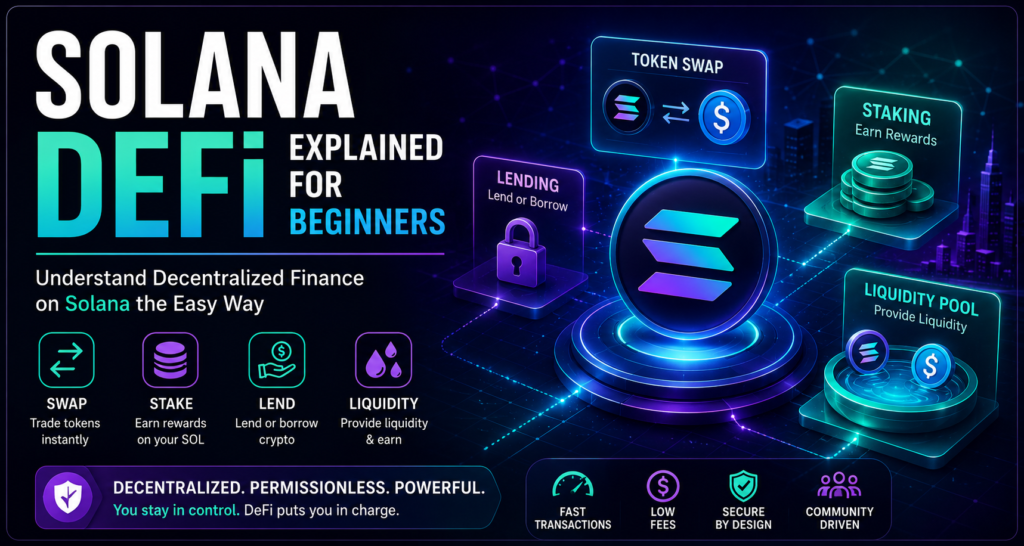
Solana DeFi Explained for Beginners
Decentralized Finance, commonly known as DeFi, has become one of the most exciting innovations in blockchain technology. Instead of relying on banks or financial institutions, DeFi uses blockchain networks and smart contracts to provide financial services directly to users. For many newcomers, this opens the door to a new way of managing digital assets—but it also introduces new concepts that can seem overwhelming at first.
The Solana blockchain has become one of the leading platforms for DeFi because of its fast transaction speeds, low network fees, and growing ecosystem of decentralized applications. Whether you’re interested in swapping tokens, earning staking rewards, or simply understanding how decentralized finance works, learning the basics of Solana DeFi is an important step in your crypto education.
In this guide, we’ll explain what DeFi is, why Solana has become a popular blockchain for decentralized finance, and the key concepts every beginner should understand before exploring this rapidly growing ecosystem.
What Is Decentralized Finance (DeFi)?
Traditional financial systems rely on centralized organizations like banks, brokerages, and payment processors to manage money and process transactions.
Decentralized Finance removes many of those intermediaries by using blockchain technology and smart contracts.
A smart contract is a self-executing computer program stored on a blockchain that automatically performs actions when predetermined conditions are met.
Instead of asking a bank to transfer funds or approve a transaction, decentralized applications allow users to interact directly with blockchain-based services.
Some common DeFi activities include:
- Swapping cryptocurrencies
- Lending digital assets
- Borrowing assets
- Staking tokens
- Providing liquidity
- Earning rewards
The goal is to make financial services more accessible while allowing users to maintain greater control over their assets.
Why Solana Has Become Popular for DeFi
Several features have helped Solana become one of the fastest-growing blockchain ecosystems for decentralized finance.
Fast Transactions
Solana is designed to process thousands of transactions quickly, allowing decentralized applications to provide a smooth user experience.
Fast transaction confirmation is particularly valuable when using decentralized exchanges or interacting with financial applications.
Low Transaction Fees
Compared to some other blockchain networks, Solana generally offers significantly lower transaction costs.
Lower fees make it more practical for beginners to explore decentralized applications without paying large network costs for everyday activities.
A Growing Ecosystem
The Solana ecosystem continues to expand with new applications, developer tools, educational resources, and community projects.
Today the ecosystem includes:
- Wallets
- Decentralized exchanges
- Lending protocols
- NFT marketplaces
- Gaming applications
- Payment platforms
- Educational communities
To better understand how these pieces fit together, read our Solana Ecosystem Explained for Beginners.
Your Wallet Is Your Key to DeFi
Before using any decentralized application, you’ll need a compatible crypto wallet.
A wallet allows you to:
- Store SOL
- Hold tokens
- Approve transactions
- Connect to decentralized applications
- Manage NFTs
- Participate in staking
Popular Solana wallets include:
- Phantom
- Solflare
- Backpack
Because your wallet provides access to your assets, learning how to secure it should always come before exploring DeFi.
If you haven’t created a wallet yet, our Phantom Wallet Setup Guide for Beginners provides a step-by-step walkthrough.
Common DeFi Activities
One of the reasons decentralized finance has grown so rapidly is the variety of services it offers.
Let’s look at some of the most common activities you’ll encounter within the Solana ecosystem.
Token Swaps
One of the simplest DeFi activities is swapping one cryptocurrency for another.
Instead of using a centralized exchange, decentralized exchanges (DEXs) allow users to exchange supported tokens directly from their wallets.
These swaps are handled by smart contracts rather than traditional financial institutions.
Staking
Staking allows SOL holders to support the Solana network by delegating their tokens to validators.
In return, participants may earn staking rewards based on validator performance and network conditions.
Staking is often one of the first decentralized finance activities beginners explore because it helps users understand how blockchain participation works.
If you’re new to staking, our What Is Solana Staking? A Beginner’s Guide explains the process in greater detail.
Lending and Borrowing
Some DeFi platforms allow users to lend supported digital assets or borrow against existing cryptocurrency holdings.
These services are governed by smart contracts rather than banks.
Although lending and borrowing create additional opportunities within decentralized finance, beginners should understand how each platform operates before participating.
Every protocol has its own rules, fees, and associated risks.
Liquidity Pools
Liquidity pools help decentralized exchanges process trades efficiently.
Rather than relying on traditional market makers, many decentralized exchanges use pools of digital assets supplied by participants.
Liquidity providers may receive incentives for contributing assets, but they should also understand concepts such as impermanent loss before participating.
Like any financial activity, liquidity provision involves both potential opportunities and risks.
Why Education Matters Before Using DeFi
The availability of decentralized financial services does not eliminate the need for research.
Every application operates differently.
Before connecting your wallet to any DeFi platform, ask yourself:
- Is this an official website?
- Have I verified the URL?
- Do I understand what the application does?
- Have I researched the platform?
- Am I comfortable with the associated risks?
Our Why Research Matters More Than Hype in Crypto article explains why slowing down and gathering reliable information often leads to better long-term decisions.
Understanding the Risks of DeFi
Decentralized Finance offers exciting opportunities, but it’s important to understand that every blockchain application carries risk. Taking time to learn about these risks can help you make more informed decisions.
Smart Contract Risk
DeFi applications rely on smart contracts to execute transactions automatically. While smart contracts remove the need for intermediaries, they are still software, and software can contain bugs or vulnerabilities.
Many established projects undergo independent security audits, but no audit can guarantee complete safety.
Market Volatility
Cryptocurrency prices can change rapidly.
Even if a DeFi application functions perfectly, the value of the assets you hold may increase or decrease significantly due to market conditions.
Never assume that participation in DeFi eliminates investment risk.
Scam Websites
Unfortunately, scammers often create fake websites that imitate legitimate DeFi applications.
Before connecting your wallet:
- Double-check the website URL.
- Bookmark official websites.
- Avoid clicking unknown links from social media or direct messages.
- Verify information using official project channels.
Wallet security should always come before convenience.
Our Solana Wallet Security Checklist outlines simple habits that can help protect your assets while exploring decentralized applications.
Understanding Impermanent Loss
If you continue exploring DeFi, you’ll likely encounter the term impermanent loss.
Impermanent loss is a concept related to providing assets to liquidity pools. It occurs when the relative prices of the assets in the pool change compared to when you deposited them.
This is an advanced topic, and beginners don’t need to master it immediately. The important takeaway is that providing liquidity involves different risks than simply holding cryptocurrency.
Take time to understand these concepts before participating.
Smart Contracts Make DeFi Possible
Smart contracts are the foundation of decentralized finance.
Think of a smart contract as a digital agreement that automatically follows predefined rules.
For example, a smart contract can:
- Process a token swap.
- Distribute staking rewards.
- Manage lending and borrowing.
- Execute transactions without a traditional financial institution.
Because these contracts run on the blockchain, they help create transparent and automated financial systems.
However, it’s still important to understand what a smart contract does before interacting with it.
How Beginners Should Explore DeFi Safely
The best way to learn decentralized finance is gradually.
Instead of trying every new application, build your knowledge step by step.
Step 1: Learn Blockchain Basics
Understand how wallets, transactions, and blockchain networks operate before using financial applications.
Step 2: Secure Your Wallet
Protect your recovery phrase, enable available security features, and verify every website before connecting your wallet.
Step 3: Understand Staking
Staking is often one of the simplest ways to learn how blockchain participation works.
Our Understanding Solana Validators and Staking Rewards article explains how validators help secure the network and how delegated staking functions.
Step 4: Research Every Platform
Don’t assume every application is trustworthy simply because someone recommends it.
Read official documentation.
Learn about the development team.
Understand how the application works.
Compare multiple sources of information.
Step 5: Start Slowly
If you decide to experiment with DeFi, consider starting with small amounts that you’re comfortable learning with.
The goal isn’t to rush into every opportunity—it’s to build confidence and experience over time.
Why Solana Continues to Attract DeFi Builders
Developers continue building decentralized applications on Solana for several reasons:
- High transaction throughput
- Low transaction fees
- Active developer community
- Expanding ecosystem
- Strong educational resources
- Growing user adoption
As more applications launch, the ecosystem continues to evolve, creating new opportunities for learning and innovation.
Continue Learning Through Official Resources
The best place to explore the growing ecosystem is through official Solana resources.
The Solana Ecosystem directory highlights wallets, DeFi protocols, developer tools, NFT platforms, payment applications, and other projects building on the network.
Final Thoughts
Decentralized Finance represents one of the most innovative areas of blockchain technology. By allowing users to interact directly with financial services through smart contracts, DeFi introduces new ways to exchange assets, earn rewards, and participate in digital economies.
However, the greatest advantage you can give yourself isn’t finding the newest protocol or following the latest trend—it’s building a strong educational foundation.
Learn how wallets work.
Understand staking.
Study blockchain security.
Research every application.
Ask questions.
Continue learning.
That approach will serve you far better than chasing hype or rushing into unfamiliar platforms.
The Solana ecosystem continues growing every day, and with patience and education, you’ll be well prepared to explore it responsibly.
Frequently Asked Questions
What is Solana DeFi?
Solana DeFi refers to decentralized financial applications built on the Solana blockchain that allow users to swap tokens, stake assets, lend, borrow, and access financial services without traditional intermediaries.
Is Solana DeFi safe?
Many DeFi platforms are built by reputable development teams, but every application carries risk. Always research projects carefully and verify you’re using official websites.
Do I need SOL to use DeFi?
Yes. SOL is generally required to pay network transaction fees when interacting with decentralized applications on the Solana blockchain.
What is a decentralized exchange (DEX)?
A decentralized exchange allows users to trade cryptocurrencies directly from their wallets using smart contracts rather than a centralized company.
Should beginners use DeFi?
Beginners should first understand wallets, blockchain security, and staking before exploring more advanced decentralized financial applications.
Continue Learning
➡️ Solana Ecosystem Explained for Beginners
➡️ Understanding Solana Validators and Staking Rewards
➡️ Solana Wallet Security Checklist
➡️ Why Research Matters More Than Hype in Crypto
➡️ Beginner’s Guide to Solana Meme Coins
Ready To Learn More?
Continue exploring the Solana ecosystem and discover how communities, developers, and education are helping shape the future of blockchain technology.
About the Author
Scott Jones is the founder of SOSANA Hub and a cryptocurrency enthusiast dedicated to helping beginners confidently navigate the Solana ecosystem.
After learning cryptocurrency through years of trial and error—including encounters with scams, fake websites, and costly mistakes—Scott created SOSANA Hub to provide educational resources that help others make informed decisions while exploring blockchain technology.
Learn more about Scott’s crypto journey.
Affiliate Disclosure
SOSANA Hub participates in affiliate programs and may earn a commission when readers purchase products or sign up through qualifying referral links. These commissions help support the educational content published on this website at no additional cost to you.
The information on SOSANA Hub is provided for educational purposes only and should not be considered financial, legal, tax, or investment advice. Always conduct your own independent research and consult a qualified financial professional before making financial decisions.